


You want a power bank that charges your devices and keeps them safe, right? Top Power Bank Brands in 2025 like Anker, Xiaomi, Zendure, and Mophie are leaders. They have smart features and are very reliable. Anker and Xiaomi are very popular in Asia Pacific. This area has more than half of the world’s market. Zendure and RAVPower make power banks that are tough and can charge in many ways. You can trust these brands for fast charging, big battery size, and cool new designs.
Key Takeaways
- Pick power banks from brands you trust. Make sure they pass tough safety tests. This helps your charging stay safe and last longer.
- Check for safety labels like UL2056, UN38.3, FCC, CE, and RoHS. These help you avoid problems like getting too hot or catching fire.
- Get a power bank that charges fast. Look for high output power, like 22.5W or more. This helps your devices charge quicker.
- Choose the right size for your needs. Use 10,000mAh for every day. Pick 20,000mAh to 30,000mAh for trips. Get bigger ones for outdoor or long trips.
- Think about how easy it is to carry. Pick slim and light models. Some have built-in cables or fold up to fit in your bag.
- Compare price, features, and warranty. Try to get the best deal. Spending a little more can mean better safety and longer use.
- Look for cool extras like wireless charging or more ports. Some have digital screens, solar charging, or use eco-friendly stuff. These make things easier.
- Make sure your power bank’s ports and fast charging work with your devices. This helps your devices charge well and fast.
Selection Criteria
Reliability
When you pick a power bank, you want it to work every time you need it. Reliable power banks go through tough tests before they reach your hands. Manufacturers run aging tests, where they use the power bank under heavy loads for a long time. This helps spot problems like battery wear or overheating. They also check how many times you can charge and discharge the power bank without losing power. Most brands test their products for at least two or three full cycles to make sure nothing goes wrong. Some even put their power banks in hot rooms to see if they still work well when it gets really warm.
Here’s what happens during reliability testing:
- Power banks get charged and discharged over and over to check for battery life.
- High-temperature tests make sure the battery and circuit board stay safe.
- Special tools measure how much energy the power bank can hold and give out.
You can trust Power Bank Brands that pass these tests. They last longer and keep your devices powered up when you need them most.
Safety
Safety should always come first. You don’t want a power bank that gets too hot or stops working suddenly. Good brands add features like overcharge protection, which stops charging when the battery is full. They also use short-circuit protection to prevent fires or damage if something goes wrong.
Look for these safety certifications:
- UL2056: Checks for electrical, fire, and heat safety.
- UN38.3: Makes sure the battery can handle changes in temperature and pressure, which is important for travel.
- FCC: Ensures the power bank won’t mess with other electronics.
- CE and RoHS: Show that the power bank meets health and environmental rules.
Certified power banks are less likely to cause problems. Always buy from authorized sellers to make sure you get a safe product.
Tip: Uncertified power banks can overheat or even catch fire. Always check for safety labels before you buy.
Charging Speed
Nobody likes waiting for their phone to charge. Charging speed depends on the power bank’s output and the type of charging it supports. Wired charging is usually faster than wireless charging. If you want the quickest charge, look for a power bank with high output power, like 22.5 watts or more.
Here’s a quick look at charging speeds for some popular models:
| Power Bank Model | Charging Speed Details | Output Power | Notes |
|---|---|---|---|
| INIU Portable Charger | Charges iPhone up to 78% in 1 hour | 3A high-speed | Adjusts speed for your device |
| YILANS 42800mAh | Fast charging with USB-C PD | 22.5W PD USB-C | Built-in cables for many devices |
| Moihosso 56800mAh | Fast charging for multiple devices | 22.5W | Great for long trips |
| Morfec 50000mAh | Multiple full charges for smartphones | 22.5W quick charge | Four outputs, LED display |
If you need to charge your phone or tablet quickly, pick a power bank with higher wattage and fast-charging support. Wireless charging is handy, but it’s a bit slower than plugging in with a cable.
Capacity
When you shop for a power bank, capacity is one of the first things you notice. Capacity tells you how much energy the power bank can store. You measure this in milliampere-hours (mAh). A higher number means you can charge your devices more times before the power bank runs out.
Most people choose a power bank with at least 10,000mAh. This size gives you two or three full phone charges. If you travel a lot or use a tablet, you might want something bigger. Power banks with 20,000mAh to 30,000mAh now hold the largest share of the market. These models are popular because they balance size and power. If you need even more, you can find power banks with 30,000mAh to 50,000mAh. These have the fastest growth in sales, but they are heavier and bulkier. Some brands even offer models above 50,000mAh for special needs, like camping or long trips.
Here’s a quick look at how capacity segments compare:
| Capacity Range | Typical Use Case | Market Share (2023) |
|---|---|---|
| 20,000mAh – 30,000mAh | Travel, tablets, multi-device | 30-35% |
| 30,000mAh – 50,000mAh | Extended trips, laptops | Fastest growth |
| Above 50,000mAh | Outdoor, niche uses | Niche, bulky |
You also want to check the battery type. Most power banks use lithium-ion batteries, which make up over 60% of the market. Some new models use lithium-polymer batteries. These are lighter and slimmer, and they are growing in popularity.
Tip: Choose a power bank with enough capacity for your daily needs, but remember that higher capacity often means more weight.
Portability
Portability matters when you carry your power bank every day. You want something that fits in your pocket or bag without weighing you down. Smaller power banks, usually below 3,000mAh, are the easiest to carry. They work well for emergencies or quick top-ups. If you need more power, look for models in the 3,001mAh to 10,000mAh range. These give you more charges but still fit in your hand or pocket.
- Power banks under 3,000mAh: Super light and easy to carry, best for emergencies.
- 3,001mAh to 10,000mAh: Good balance of size and power, great for commuters and travelers.
- Lithium-polymer batteries: Make power banks slimmer and lighter.
- Extra features like multiple ports and fast charging: Add convenience without making the power bank too bulky.
You might notice that some power banks come with built-in cables or foldable designs. These features make them even easier to carry. Always check the size and weight before you buy. A slim, compact design is the most popular choice for most people.
Note: If you plan to carry your power bank in your pocket, check the dimensions and weight. A slim model feels much more comfortable.
Value
You want the best bang for your buck. Value is not just about the lowest price. It’s about what you get for your money. A good power bank offers reliable performance, safety features, and enough capacity for your needs. Some brands add extras like fast charging, built-in cables, or wireless charging. These features can save you time and hassle.
When you compare prices, look at the warranty and customer support. Trusted brands often give you better service and longer warranties. This can save you money if something goes wrong. Also, check for safety certifications. A cheap power bank without proper safety features can damage your devices or even cause a fire.
- Look for a balance of price, features, and reliability.
- Consider the warranty and customer support.
- Don’t forget about safety certifications.
Tip: Sometimes, spending a little more upfront gets you a power bank that lasts longer and works better.
Special Features
When you look for a new power bank, you want more than just a big battery. You want features that make your life easier and your devices safer. Let’s check out some of the coolest special features you can find in today’s top power banks.
Wireless Charging: Many new power banks let you charge your phone without any cables. Just place your phone on top, and it starts charging. Some models support the latest Qi2 and MagSafe standards, so you get faster and more reliable wireless charging. This is perfect if you hate carrying extra cords.
Fast Charging: You don’t want to wait hours for your phone to charge. Fast-charging power banks use new technology to fill up your battery quickly. Some even use GaN (gallium nitride) chargers, which are smaller and more efficient than old chargers. You can get your phone back to 80% in less than an hour with the right power bank.
Multiple Ports and USB Type-C: Do you have more than one device? Many power banks now come with several ports, including USB Type-C. This means you can charge your phone, tablet, and earbuds all at once. Some even have built-in cables, so you never have to search for the right cord.
Smart Digital Displays: No more guessing how much battery you have left. Some power banks have digital screens that show the exact percentage of power remaining. This helps you plan when to recharge your power bank.
Solar Charging: If you love the outdoors, you’ll like solar power banks. These models have small solar panels that let you recharge using sunlight. They’re great for camping or hiking trips when you can’t find a plug.
AI Battery Management: Some advanced power banks use AI to manage charging. This keeps your devices safe from overheating or overcharging. It also helps your power bank last longer by protecting the battery.
Eco-Friendly Materials: More brands now use biodegradable or recycled materials for their cases. This helps protect the environment while you charge your devices.
Tip: Always check if your power bank has safety features like overheat protection and short-circuit prevention. These keep you and your devices safe.
You can also find power banks with LED flashlights, rugged designs for outdoor use, and even battery cases that snap onto your phone. With so many options, you can pick a power bank that fits your style and needs.
Top Power Bank Brands
Anker
Popular Models
Anker stands out as one of the most trusted Power Bank Brands in 2025. You will see their products everywhere, from airports to classrooms. Here are some of their most popular models:
| Product Model | Capacity (mAh) | Average User Rating | Number of Reviews | Price | Key Features |
|---|---|---|---|---|---|
| Anker Portable Charger 10,000 | 10,000 | 4.5/5 | ~100,000 | $22 | USB-A, USB-C, Micro-USB ports; reliable for multiple recharges |
| Anker PowerCore 5,000 | 5,000 | 4.5/5 | ~30,000 | $22 | Lightweight, compact, USB-A and Micro-USB ports |
| Anker PowerCore 25,000 | 25,000 | 4.7/5 | ~15,000 | $99 | 165W output, USB-C/USB-A, retractable cables, power display |
Key Features
You get a lot with Anker. Their power banks offer:
- Fast charging for phones, tablets, and even laptops.
- Multiple ports, including USB-C and USB-A.
- Smart digital displays on newer models.
- Durable build that can handle daily use.
- Safety features like overcharge and short-circuit protection.
The Verge recently highlighted Anker’s 25,000mAh model at CES 2025. This power bank delivers up to 165W, so you can charge a laptop and phone at the same time. It even has retractable cables and a screen that shows how much power you have left.
Pros and Cons
Tip: Anker is a favorite for reliability, but every brand has strengths and weaknesses.
Pros:
- Very reliable and long-lasting.
- Fast charging for many devices.
- Great safety features.
- Lots of positive reviews and high ratings.
Cons:
- Some models cost more than other brands.
- Larger models can feel heavy in your bag.
Best Use Cases
You should pick Anker if you want a power bank that just works every time. It’s perfect for:
- Students who need to charge phones and tablets at school.
- Travelers who want fast charging at airports or hotels.
- Anyone who needs to charge a laptop on the go.
- People who care about safety and reliability.
Belkin
Popular Models
Belkin is another big name among Power Bank Brands. You might know them for their phone chargers and cables, but their power banks are just as good. Here are some top picks:
- Belkin BoostCharge Power Bank 20K: 20,000mAh, USB-C and USB-A ports, supports fast charging.
- Belkin Magnetic Wireless Power Bank 10K: 10,000mAh, MagSafe compatible, wireless charging for iPhones.
- Belkin Pocket Power 10K: 10,000mAh, slim design, lightweight, USB-A and USB-C.
Key Features
Belkin gives you:
- Multi-port charging, so you can power up more than one device at once.
- Wireless charging on some models, including MagSafe for iPhones.
- Slim and stylish designs that fit in your pocket.
- LED indicators to show battery level.
- Built-in safety features to protect your devices.
Pros and Cons
Pros:
- Great for charging multiple devices at once.
- Wireless charging is super convenient.
- Trusted brand with good customer support.
Cons:
- Some models cost more than similar options from other brands.
- Wireless charging is a bit slower than wired charging.
Best Use Cases
Belkin works well for you if you:
- Use an iPhone and want MagSafe wireless charging.
- Need to charge more than one device at the same time.
- Like slim, easy-to-carry designs.
- Want a power bank that looks good and works well for daily use.
Baseus
Popular Models
Baseus has become a favorite for people who want style and performance. You can find these popular models:
- Baseus Blade 100W Power Bank: 20,000mAh, ultra-slim, supports fast charging for laptops.
- Baseus Magnetic Mini Power Bank: 6,000mAh, MagSafe compatible, compact for iPhones.
- Baseus Adaman Metal Power Bank: 20,000mAh, digital display, sturdy aluminum body.
Key Features
You get a lot of value with Baseus. Here’s what stands out:
- Sleek, minimalist designs with premium materials like aluminum alloy.
- High output efficiency, reaching up to 90% at 140W.
- Fast charging for phones, tablets, and laptops.
- Digital displays that show exact battery percentage.
- Good heat control, even under heavy use.
- Competitive prices, usually between $20 and $50.
Baseus tests their power banks for efficiency and safety. For example, their models keep cool even when charging at 140W for 30 minutes. You can recharge some models in just over an hour with a fast charger.
Pros and Cons
Pros:
- Stylish and slim designs.
- High efficiency and fast charging.
- Affordable compared to other premium brands.
- Good safety and heat management.
Cons:
- Some models may not be as widely available in all regions.
- Fewer customer support options than bigger brands.
Best Use Cases
Baseus is a great pick if you:
- Care about how your power bank looks and feels.
- Need fast charging for laptops or tablets.
- Want a digital display to track battery life.
- Prefer a balance of price and quality.
Note: Baseus stands out for its design and efficiency, making it a strong choice among Power Bank Brands for students, travelers, and anyone who wants a stylish, reliable charger.
Xiaomi
Popular Models
Xiaomi is famous for its smartphones, but its power banks are also popular. You can find these models almost everywhere:
- Xiaomi Mi Power Bank 3 Pro: 20,000mAh, USB-C two-way fast charging, charges laptops.
- Redmi Power Bank 20,000mAh: Dual USB-A output, slim, affordable.
- Xiaomi Mi Wireless Power Bank 10,000mAh: Wireless charging, USB-C and USB-A ports, lightweight.
- Xiaomi Pocket Edition Pro: 10,000mAh, very small, built-in cables.
Xiaomi power banks are sold in many countries. They have a simple look and the MI logo, so they are easy to spot.
Key Features
Xiaomi gives you a lot for your money. You get:
- Two USB ports to charge two devices at once.
- Fast charging for both charging and recharging.
- Slim and light designs that fit in your pocket.
- Some models have built-in cables, so you don’t need to look for one.
- The battery cells last through many uses.
- They work well with other Xiaomi devices.
Xiaomi keeps prices low but still adds good features. Many young people like Xiaomi because it listens to what users want and keeps making better products.
Pros and Cons
Tip: Xiaomi is a smart choice if you want value and features.
Pros:
- Very affordable compared to other brands.
- Good quality and works well.
- Lots of features for the price.
- Easy to find in many places.
Cons:
- Some models do not charge as fast as others.
- Not as many fancy materials as expensive brands.
- Customer support is different in each country.
Best Use Cases
Pick Xiaomi if you:
- Want a cheap power bank that works well.
- Need to charge more than one device at once.
- Like slim and easy-to-carry designs.
- Use other Xiaomi devices and want them to work together.
Xiaomi sells lots of power banks because they are cheap and work well. They have features like two USB ports and fast charging. Many students and travelers like Xiaomi because it is a good deal.
Zendure
Popular Models
Zendure is known for making tough and strong power banks. Here are some of their best models:
- Zendure SuperTank Pro: 26,800mAh, four USB-C ports, OLED display, charges laptops.
- Zendure SuperMini: 10,000mAh, very small, fast charging, cool colors.
- Zendure SuperBase V: High-capacity, made for outdoor trips and backup power.
Zendure power banks look tough and have digital screens.
Key Features
Zendure power banks last a long time. You get:
- Strong designs that can handle drops and bumps.
- Many USB-C ports to charge several devices at once.
- Fast charging for laptops, tablets, and phones.
- Screens that show battery and charging info.
- Batteries that last a long time and show the right amount of power.
Tech reviewers have tested Zendure’s SuperTank Pro for years. It kept working well even after lots of use. This shows Zendure is strong and reliable.
Pros and Cons
Note: Zendure is great if you need a power bank that can handle rough use.
Pros:
- Very strong and tough.
- Fast charging for many devices, even laptops.
- Shows battery level correctly and lasts long.
- Good for travel and outdoor trips.
Cons:
- Costs more than basic brands.
- Some models are heavy and big.
- Not sold in every store.
Best Use Cases
Zendure is best if you:
- Travel a lot or spend time outside.
- Need to charge laptops and big devices.
- Want a power bank that can survive drops.
- Like seeing battery info on a screen.
Zendure is one of the best Power Bank Brands for people who need something strong and reliable.
Mophie
Popular Models
You see Mophie in Apple Stores and tech shops. Here are some of its most popular power banks:
- Mophie Powerstation XXL: 20,000mAh, three USB ports, fabric finish.
- Mophie Powerstation Plus: 10,000mAh, built-in cable for Lightning and USB-C.
- Mophie Snap+ Juice Pack Mini: 5,000mAh, MagSafe, wireless charging.
Mophie power banks look nice and feel soft, with simple designs.
Key Features
Mophie cares about style and making things easy. You get:
- Built-in cables or adapters for easy charging.
- Wireless charging, including MagSafe for iPhones.
- Many ports to charge several devices.
- Nice materials like fabric or soft plastic.
- Lights to show battery level.
Mophie works well with Apple devices, but you can use it with Android too.
Pros and Cons
Tip: Mophie is a good pick if you want a stylish and easy power bank.
Pros:
- Looks nice and feels premium.
- Built-in cables and wireless charging.
- Works well with Apple devices.
- Reliable and safe to use.
Cons:
- Costs more than many other brands.
- Some models have smaller batteries.
- Not many choices for very big batteries.
Best Use Cases
Pick Mophie if you:
- Want a power bank that looks and feels nice.
- Use an iPhone or other Apple devices.
- Like built-in cables and wireless charging.
- Need a charger for daily use or travel.
Mophie is a top Power Bank Brand for style and easy use, especially for Apple fans.
Skyfie
Have you ever worried about your power bank getting too hot or not lasting long enough? Skyfie wants to change how you think about portable charging. This brand is making waves in 2025 with its focus on safety and long-lasting power. If you want a power bank that feels both smart and safe, Skyfie is a name you should know.

Skyfie stands out from other Power Bank Brands because it uses new battery technology. Instead of the usual liquid inside, Skyfie uses a semi solid-state battery. This means the battery has a gel-like material that is much more stable. You get a power bank that does not swell, overheat, or catch fire, even if you drop it or leave it in the sun. That’s a big deal if you carry your charger everywhere.
You will also notice that Skyfie power banks are lighter and easier to carry. They fit in your bag or pocket without adding extra weight. Charging is fast and safe, whether you use a cable or go wireless. You can even charge more than one device at the same time. Skyfie tests every power bank to make sure it meets strict safety rules. You get peace of mind every time you plug in.
Tip: If you want a power bank that lasts longer and keeps you safe, Skyfie is a smart pick.
Popular Models:SF-SPB21

The SF-SPB21 is Skyfie’s most popular model right now. People love it because it brings together all the best features in one small package. You get a compact design, so it’s easy to take with you. The SF-SPB21 supports both wired and wireless charging, which means you can charge your phone, tablet, or earbuds however you like.
Here’s what makes the SF-SPB21 special:
- Semi solid-state battery for better safety and longer life
- Fast charging for all your devices
- Lightweight and easy to carry
- Supports charging more than one device at once
- Designed to handle bumps, drops, and heat
You can trust the SF-SPB21 to keep up with your busy life. Whether you’re at school, traveling, or just out with friends, this power bank won’t let you down.


Key Features: use Semi Solid-state Battery, safe and cycle charging 2000times
Skyfie’s key feature is its semi solid-state battery. This is not just a small upgrade. It changes how safe and strong your power bank can be. Here’s why you should care:
- The battery uses a gel-like material instead of liquid, so it won’t catch fire or swell up.
- You can charge and use the power bank up to 2,000 times. That’s about twice as long as most regular power banks.
- It stays cool, even when you charge it fast or use it in hot weather.
- The battery does not break down easily, so you get more years of use.
- You can charge more than one device at once, and it works with both cables and wireless charging.
Skyfie also makes sure every power bank passes tough safety tests. You get a product that is ready for real life, not just the lab. If you want a power bank that is safer, lasts longer, and is easy to use, Skyfie is a great choice.
Other Notable Brands
When you look beyond the biggest names, you find many other Power Bank Brands that offer great value, smart features, or unique designs. Let’s check out some of these brands and see what makes each one stand out.
Nimble
Nimble cares about the planet. You get power banks made from recycled plastic and eco-friendly packaging. Nimble also lets you send back old electronics for recycling. Their chargers work well for daily use and come in simple, clean designs. If you want to help the environment while charging your phone, Nimble is a smart pick.
Nitecore
Do you love the outdoors? Nitecore makes power banks for adventure. Their models are tough, water-resistant, and work in extreme weather. You can drop them or use them in the rain. Nitecore also adds flashlights and emergency features. These power banks are perfect for hiking, camping, or emergency kits.
Energizer
You probably know Energizer from batteries. Their power banks are just as reliable. Energizer offers a wide range of sizes, from pocket-sized to high-capacity models. Many have built-in cables and LED indicators. You get a trusted brand with good safety features and solid performance.
Skullcandy
Skullcandy is famous for headphones, but they also make cool-looking power banks. You get bright colors and bold designs. These chargers are small and easy to carry. They work best for students or anyone who wants a fun, stylish charger for daily use.
BioLite
BioLite stands out if you like camping or being off the grid. Their power banks often include solar charging and can power small lights or stoves. You can use them to charge your phone or run a camp lantern. BioLite helps you stay connected, even in the wild.
Goal Zero
Goal Zero is all about outdoor power. Their power banks are rugged and can handle drops, dust, and rain. Some models have solar panels, so you can recharge with sunlight. You get lots of ports and big batteries for long trips. If you need power far from home, Goal Zero is a top choice.
Bluetti
Bluetti makes big, powerful chargers. You can use them for laptops, cameras, or even small appliances. Some Bluetti models work as backup power for your home. They are heavier, but you get lots of energy and fast charging. Bluetti is great for road trips, camping, or emergency backup.
UGREEN
UGREEN offers affordable power banks with lots of features. You get fast charging, multiple ports, and slim designs. UGREEN models work well for students and travelers. They are easy to find online and have good reviews for reliability.
Aukey
Aukey gives you a good mix of price and performance. Their power banks come in many sizes and support fast charging. Some models have built-in cables or wireless charging. Aukey is a solid choice if you want a dependable charger without spending too much.
RAVPower
RAVPower is known for strong, high-capacity chargers. You get fast charging, sturdy builds, and lots of ports. RAVPower models are popular with travelers and people who need to charge many devices at once. They also have good safety features.
Lenovo
Lenovo makes more than laptops. Their power banks are simple, slim, and easy to use. You get reliable charging for phones and tablets. Lenovo models are a good match if you already use Lenovo devices.
Panasonic
Panasonic offers safe, long-lasting power banks. You get good battery life and strong safety features. Panasonic models are not flashy, but they work well and last a long time. They are a good pick for anyone who wants a charger they can trust.
Sony
Sony brings style and smart features to their power banks. You get slim designs, fast charging, and good battery health. Sony models often include smart charging to protect your devices. They work well for daily use and travel.
Philips
Philips makes simple, affordable power banks. You get basic charging, slim shapes, and easy-to-read battery lights. Philips models are great for students or anyone who needs a backup charger for emergencies.
Tip: Not sure which brand fits your needs? Check out this table for a quick comparison of some popular models:
| Brand & Model | Capacity (mAh) | Charging Efficiency (%) | Key Strengths & Use Cases | Price Range (Approx.) | Additional Features |
|---|---|---|---|---|---|
| Miady 2-Pack | 10,000 each | ~79 | Best value for budget users; dual pack; charges 2 devices | $18 – $28 | Compact, no built-in cables or plugs |
| LoveLedi 15000 Dual 2-Pack | 15,000 each | ~80 | Good value; slightly higher capacity; dual pack | ~$24 – $30 | Dual pack convenience |
| Mophie PowerStation XXL 20000 | 20,000 | 83 | High capacity; excellent for laptops and gaming devices | ~$42 – $60 | Fast recharge; USB-C PD support |
| INIU 22.5W 20000 | 20,000 | ~82 | Large capacity; solid charging efficiency | ~$27 – $56 | Fast charging capability |
| Anker PowerCore Slim 10000 | 10,000 | ~79 | Portable; decent efficiency | ~$20 – $25 | Slim design |
| TG90° 10000mAh with AC Plug | 10,000 | N/A | Integrated cables and wall plug; charges multiple devices | ~$44 – $50 | Built-in AC wall plug and cables |
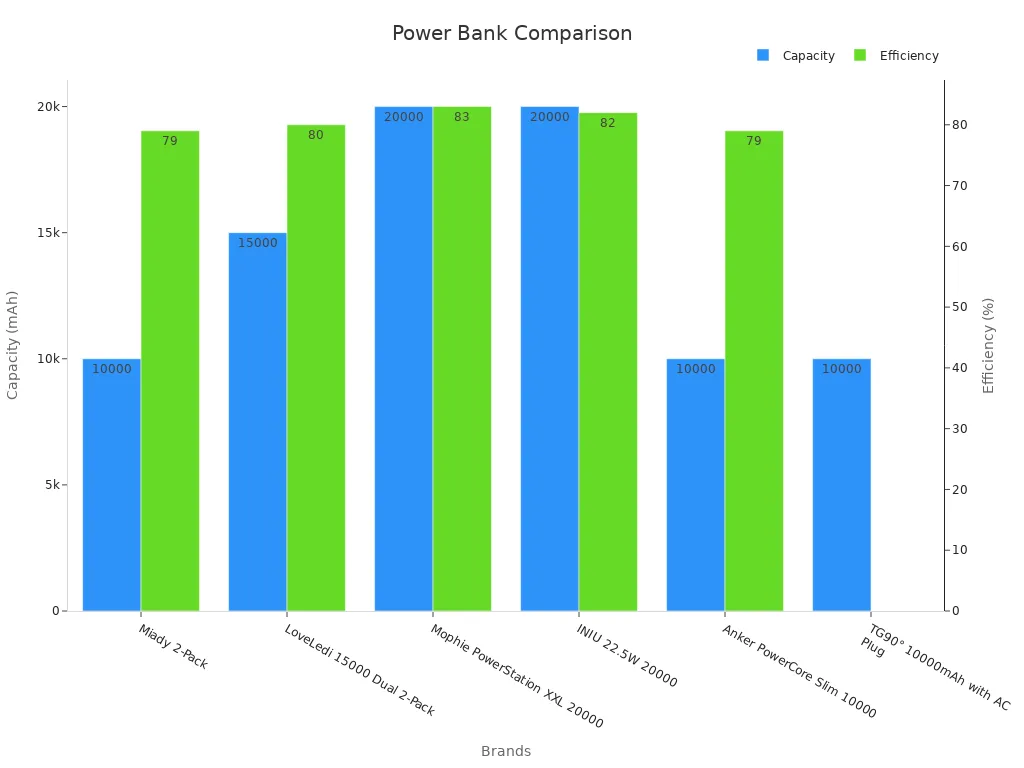
You can see that each brand has its own strengths. Some focus on value, others on high capacity or special features. When you explore these Power Bank Brands, you find options for every need and budget.
Power Bank Brands Comparison
Comparison Table
You probably want to see how the top Power Bank Brands stack up side by side. A good comparison table helps you spot the differences fast. I’ve gathered real data using tools like USB power meters and battery testers. These tools check things like charging speed, real battery size, and how many times you can use the power bank before it wears out.
Here’s a handy table to help you compare some of the best options:
| Brand & Model | Capacity (mAh) | Max Output (W) | Ports | Fast Charging | Weight (g) | Special Features | Price Range |
|---|---|---|---|---|---|---|---|
| Anker PowerCore 25,000 | 25,000 | 165 | USB-C, USB-A | Yes | 520 | Retractable cables, display | $99 |
| Belkin BoostCharge 10K | 10,000 | 20 | USB-C, USB-A | Yes | 218 | Slim, integrated cable | $35 |
| Baseus Blade 100W | 20,000 | 100 | USB-C, USB-A | Yes | 490 | Ultra-slim, digital display | $60 |
| Xiaomi Mi Power Bank 3 Pro | 20,000 | 45 | USB-C, USB-A | Yes | 400 | Two-way fast charging | $45 |
| Zendure SuperTank Pro | 26,800 | 100 | 4x USB-C | Yes | 580 | OLED display, rugged build | $130 |
| Mophie Powerstation XXL | 20,000 | 18 | 3x USB | Yes | 390 | Fabric finish, built-in cable | $60 |
| Skyfie SF-SPB21 | 10,000 | 22.5 | USB-C, Wireless | Yes | 210 | Semi solid-state battery | $55 |
You can use this table to pick the right power bank for your needs. Look at the features that matter most to you, like weight, charging speed, or special extras.
Best for Travel
When you travel, you need a power bank that is light, safe, and charges your devices fast. You don’t want to run out of power in the middle of a trip. For short trips, a 6,000–10,000mAh model fits in your pocket and gives you two full phone charges. For longer adventures, you might want something bigger, like 20,000mAh or more.
Travelers love models like the Anker PowerCore 25,000 for its huge capacity and fast charging. The Belkin BoostCharge 10K is slim and easy to carry. If you go hiking or camping, brands like Goal Zero and BioLite make rugged power banks that handle rough weather and even charge with solar panels.
- UGreen 145W (25,000mAh) is great for charging tablets and laptops.
- Anker 521 (5,000mAh) is perfect for phones and fits in your pocket.
- BioLite Charge 80 PD works well for backpacking and outdoor trips.
Tip: Usable capacity is about 60% of what’s listed, so plan ahead. Fast charging and USB-C ports help you recharge quickly at airports or hotels.
Best for Daily Use
For daily use, you want a power bank that is easy to carry and charges your phone at least twice. Most people pick a 10,000mAh model. It’s not too heavy and fits in your bag or pocket. Look for features like fast charging, built-in cables, and digital displays.
Here’s a quick look at some top picks for daily use:
| Model | Capacity (mAh) | Ports | Max Output (W) | Fast Charging Protocols | Size/Weight (approx.) | Key Features & Usage Suitability |
|---|---|---|---|---|---|---|
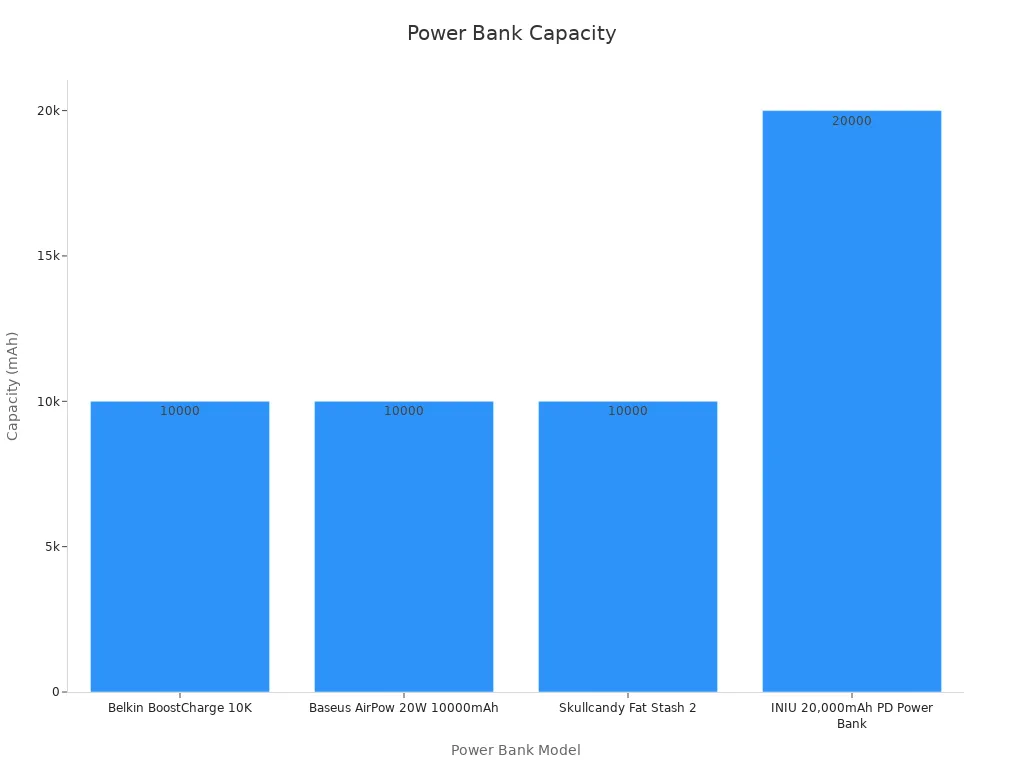
| Belkin BoostCharge 10K | 10,000 | 1 integrated USB-C, 1 USB-C | 20 (single) / 15 (dual) | USB-C PD 20W | 5.3″ × 2.6″ × 0.6″, 218 g | 2+ phone charges, no extra cables needed, ideal for daily use |
| Baseus AirPow 20W 10000mAh | 10,000 | 1 USB-C, 1 USB-A, micro-USB in | 20 | USB-C PD 20W, QC 3.0 on USB-A | 5.4″ × 2.5″ × 0.9″, 245 g | Fast charging, supports old/new devices, budget-friendly |
| Skullcandy Fat Stash 2 | 10,000 | 2 USB-A, 1 USB-C in/out | 18 (est.) | USB-C PD 18W | 4.2″ × 2.5″ × 0.87″, 201 g | Multi-port, includes multi-tip cable, compact and well-built |
| INIU 20,000mAh PD Power Bank | 20,000 | 1 USB-C, 2 USB-A | 22.5 | QC4.0+/PD 22.5W | 5.3″ × 2.7″ × 1.0″, 363 g | Large capacity, fast charging, digital LED display, heavier |
You can see that these models give you a good mix of size, speed, and features. If you want something light, go for the Belkin or Skullcandy. If you need more power, try the INIU 20,000mAh.
Note: For daily use, pick a power bank that fits your routine. Look for one with at least 60% efficiency and a max output of 18–22W for fast charging.
Best for Outdoor/Backpacking
If you love hiking, camping, or spending time off the grid, you need a power bank that can handle rough conditions. Not all chargers are tough enough for the outdoors. You want something that is light, strong, and works well in cold or wet weather.
Let’s look at what matters most for outdoor use:
- Durability: You want a power bank that survives drops and bumps. Models like the Nitecore NB 10000 Gen 3 and BioLite have strong cases. They keep working even after being dropped from 8 feet.
- Weight and Packability: Every ounce counts when you carry your gear. The Goal Zero Flip 24 is one of the lightest, weighing just 0.30 lbs. Nitecore NB 10000 Gen 3 is also very light and easy to pack.
- Efficiency: You need a charger that gives you the most power for its weight. Nitecore NB 10000 Gen 3 leads in efficiency, so you get more charges without extra weight.
- Cold Weather Performance: Some power banks lose power in the cold. Goal Zero Flip 24 and Zendure models keep their capacity even when it’s chilly.
- Features: Look for pass-through charging, multiple ports, and easy-to-read battery indicators. Nitecore, BioLite, and Zendure offer these extras.
Here’s a quick table to help you compare:
| Model | Weight (lbs) | Durability | Cold Weather | Efficiency | Special Features |
|---|---|---|---|---|---|
| Nitecore NB 10000 Gen 3 | 0.33 | Survives drops | Loses some capacity | Very high | Multiple ports, pass-through |
| Goal Zero Flip 24 | 0.30 | Survives drops | Keeps capacity | Lower | Lightest, simple design |
| BioLite | Heavier | Most durable | Good | Good | Rugged, solar options |
| Zendure | Medium | Survives drops | Keeps capacity | Good | Pass-through, clear display |
Tip: For backpacking, pick a power bank that is light, tough, and works in all weather. Nitecore and BioLite are top choices for outdoor adventures.
Best for Multi-Device Charging
Do you carry more than one device? Maybe you have a phone, tablet, and earbuds. You need a power bank that can charge them all at once. Many Power Bank Brands now make chargers with several ports and high output.
Here’s what to look for:
- Multiple Ports: Choose a power bank with at least two or three ports. USB-C and USB-A are the most common.
- High Output: If you want to charge a laptop or tablet, look for models with 100W or more. Some, like the Nexode 200W, can handle even bigger jobs.
- Smart Features: Some power banks show you which ports are active and how much power each device gets. This helps you manage your charging better.
- Pass-Through Charging: This lets you charge the power bank and your devices at the same time.
Check out this table for some top multi-device chargers:
| Model | Max Output | Ports | Special Features |
|---|---|---|---|
| Nexode 100W | 100W | 1x USB-C, 1x USB-A | Fast charging, compact |
| Nexode 130W | 130W | 2x USB-C, 1x USB-A | Multiple devices, smart display |
| Nexode 200W | 200W | 2x USB-C, 1x USB-A | Pass-through, real-time info |
You want a charger that keeps up with your busy life. Look for quick charge support, built-in cables, and clear battery lights. The best models keep charging fast, even when you plug in more than one device.
Note: If you travel with family or friends, a multi-device power bank saves time and keeps everyone powered up.
Best Budget Option
You don’t have to spend a lot to get a good power bank. Many brands offer reliable chargers for less than $25. When you shop on a budget, focus on the balance between price, capacity, and size.
Here’s a quick look at some top budget picks:
| Model | Capacity (mAh) | Ports | Size (inches) | Weight (oz) | Price (approx.) |
|---|---|---|---|---|---|
| Anker PowerCore 5000 | 5,000 | 1x USB-A, 1x Micro-USB | 4.2 x 1.2 x 1.2 | 4.7 | Just over $20 |
| Otterbox Fast Charge | 20,000 | 1x USB-A, 1x USB-C | 6.26 x 3.08 x 0.92 | 16 | Around $55 |
The Anker PowerCore 5000 is a favorite for students and travelers. It’s small, light, and costs just over $20. You get enough power for one or two phone charges. The Otterbox Fast Charge gives you more capacity and fast charging for a bit more money.
Tip: For the best value, pick a power bank that matches your daily needs. You don’t need the biggest battery—just one that fits your routine and budget.
Choosing Power Bank Brands
For Travel
When you travel, you want a power bank that keeps your devices charged and follows airline rules. Not every charger is safe to bring on a plane. Most airlines only let you carry power banks in your hand luggage. You cannot put them in checked bags because of fire risks. Always check the label on your power bank. It should show the capacity in Wh or mAh. If it is under 100Wh, you can bring it without asking the airline. If it is between 100Wh and 160Wh, you need airline approval. Anything bigger is not allowed.
Here’s a quick table to help you remember the main rules:
| Rule Category | Details |
|---|---|
| Carry-on Only | Power banks must go in your cabin bag, not checked luggage. |
| Capacity Limits | Up to 100Wh: OK. 100-160Wh: Need approval. Over 160Wh: Not allowed. |
| Quantity Limits | Unlimited under 100Wh. Max two between 100-160Wh (with approval). |
| Labeling | Must show capacity clearly. |
| Safety Certifications | Look for CE, FCC, RoHS, UL2056, UN38.3. |
| Safety Features | Overheat, overcharge, and short-circuit protection. |
Most airlines, like Singapore Airlines and AirAsia, do not let you use or charge power banks during the flight. Always store your charger under your seat or in the seat pocket. Pick a power bank with safety certifications and built-in protections. This keeps you and your devices safe while you travel.
Tip: Choose a power bank under 100Wh with clear labeling and safety marks. This helps you avoid problems at airport security.
For Daily Use
You need a power bank that fits your routine. For school, work, or running errands, a slim and light charger works best. Look for something around 10,000mAh. This size gives you two or three phone charges but still fits in your pocket or bag. Many people like models with built-in cables or digital displays. These features make charging simple and quick.
Pick a brand that offers good customer support and a warranty. You want a charger that lasts and keeps your phone safe. Some Power Bank Brands add extra features like fast charging or wireless charging. These can save you time when you are in a hurry.
Note: For daily use, balance size, weight, and charging speed. A compact power bank with smart features makes life easier.
For Outdoor Use
If you love hiking, camping, or spending time outside, you need a tough power bank. Outdoor chargers must handle rain, dust, and drops. Look for models with an IP67 rating. This means your charger is dustproof and can survive getting wet. Some outdoor power banks have rubber covers or screw caps to protect the ports.
Many outdoor chargers go through special tests. They work well in cold, hot, or rough weather. Some even have solar panels for charging in the wild. Studies show that these power banks last longer and have less impact on the environment than solar chargers. Brands like Goal Zero and NestOut make models with strong cases and water protection. You can trust these chargers to keep your devices powered up, even in tough places.
- IP67 rating: Dustproof and water-resistant
- Rubber or silicone covers: Protect against rain and dirt
- Strong cases: Survive drops and rough use
Tip: For outdoor adventures, pick a power bank with a high durability rating and weather protection. This keeps your devices safe wherever you go.
For Multi-Device Charging
Do you have a phone, tablet, and wireless earbuds? You might want to charge them all at once. Some Power Bank Brands make this simple. They add more charging ports and higher power. Try to find a power bank with two or three ports. USB-C and USB-A are the most common ports. If you use a laptop or tablet, check for high-watt charging. Some power banks can do 60W or even 100W.
Many new power banks let you charge several devices at once. They do not slow down when you plug in more things. Some models have built-in cables. This means you do not need to look for extra cords. Digital screens can show which ports are working. They also tell you how much power each device is getting. This helps you know what is happening while you charge.
Here is a quick checklist for picking a multi-device charger:
- Two or three charging ports (USB-C, USB-A)
- High output (60W or more for laptops)
- Smart power sharing so all devices charge fast
- Built-in cables or adapters for easy use
- Clear battery display
If you travel with family or friends, a multi-device power bank is helpful. You can share one charger instead of carrying many. Some brands let you charge the power bank and your devices at the same time. This is called pass-through charging.
Tip: Always check the total output. If you plug in too many things, some power banks slow down. Pick a model that fits what you really need.
Safety and Airline Rules
You may wonder if you can take your power bank on a plane. Airlines and airports have strict rules for battery safety. Lithium-ion batteries can catch fire if they get damaged or too hot. Since 2015, battery fires on planes have gone up by almost 400%. The FAA now sees at least one battery problem every week. In 2025, some flights had to land early because of power bank fires.
Here is a table to help you see the main rules and risks:
| Aspect | Details |
|---|---|
| Incident Increase | Lithium-ion battery fires on planes rose by 388% since 2015; FAA reports at least one incident per week since 2021 |
| Recent Incident Examples | Air Busan flight diverted (Jan 2025) due to power bank fire; Southwest emergency landing (Jun 2025) from smoking battery |
| TSA Penalties for Power Bank Violations | Confiscation for power banks in checked baggage; fines up to $17,062 for >160 Wh violations; warnings and possible no-fly status for repeat offenders |
| TSA Battery Capacity Limits | ≤100 Wh allowed in carry-on without approval; 100–160 Wh require airline approval (max 2 devices); >160 Wh prohibited |
| International Regulations | ICAO and IATA set baseline rules: UN 38.3 testing, max 100 Wh without approval, 100–160 Wh with approval, >160 Wh banned; IATA mandates max 30% state of charge from 2025 |
| Regional Variations | EU (EASA) follows IATA/ICAO but some airlines have stricter rules (e.g., Lufthansa limits to ≤100 Wh, Brussels Airlines needs advance registration for >100 Wh) |
You must always put your power bank in your carry-on bag. Never put it in checked luggage. Most airlines let you bring power banks up to 100Wh with no special approval. If your charger is between 100Wh and 160Wh, you need to ask the airline first. You can only bring two of these. Anything bigger is not allowed on planes. Make sure your power bank has clear labels showing its size. If you break these rules, security can take your charger, fine you, or even ban you from flying.
Note: Always check your airline’s website before you fly. Rules can change, and some airlines have extra rules.
Lifespan and Warranty
You want your power bank to last a long time. Most power banks work well for about 500 to 2,000 charge cycles. A charge cycle means using all the battery and then charging it again. Some new Power Bank Brands use better batteries that last longer. For example, semi solid-state batteries can handle more cycles and stay safe.
Check the warranty before you buy. Good brands give you at least a one-year warranty. Some offer two years or more. A longer warranty means the company trusts its product. If your power bank stops working early, a good warranty saves you money.
Here are some tips to help your power bank last longer:
- Do not leave it in hot cars or direct sunlight.
- Try not to let the battery go to zero too often.
- Use the right charger and cable.
- Store it in a cool, dry place when not using it.
If you take care of your power bank, it will keep your devices charged for years. Always keep your receipt and warranty card in case you need help.
Tip: Register your power bank online if you can. This makes warranty claims faster and easier.
Compatibility
When you pick a power bank, you want it to work with all your devices. Compatibility means your charger and your gadgets speak the same language. If you get this right, you avoid headaches and wasted money.
First, check the ports on your devices. Most phones and tablets use USB-C or Lightning. Some older gadgets still use Micro-USB. Look at your power bank. Does it have the right ports? Many new Power Bank Brands offer USB-C, USB-A, and sometimes even built-in cables. This makes charging easy. You do not need to carry extra cords.
Next, think about charging speed. Some devices support fast charging, but only if the power bank matches the right protocol. For example, iPhones use Power Delivery (PD), while many Android phones use Quick Charge (QC). If your power bank supports both, you get the fastest charge possible. If not, your phone may charge slowly.
Here’s a quick table to help you match your device with the right power bank:
| Device Type | Common Port | Fast Charging Protocol | What to Look For in a Power Bank |
|---|---|---|---|
| iPhone (newer) | Lightning/USB-C | PD | USB-C port, PD support |
| Android (newer) | USB-C | QC, PD | USB-C port, QC/PD support |
| Older devices | Micro-USB | None/QC | USB-A or Micro-USB port |
| Laptops | USB-C | PD (60W+) | High-watt USB-C PD port |
| Wireless earbuds | USB-C/Lightning | None | Low-power USB-A/C port |
You should also check if your power bank supports pass-through charging. This lets you charge your devices while the power bank itself charges. It saves time, especially if you have only one wall outlet.
Some Power Bank Brands add smart chips. These chips detect your device and adjust the power. You get safe and efficient charging every time. If you use Apple, Samsung, or Xiaomi products, look for brands that mention compatibility with those names.
Tip: Always read the product details before you buy. Make sure your power bank works with your phone, tablet, or laptop. If you use wireless charging, check if your device supports Qi or MagSafe.
If you travel a lot, you may use gadgets from different countries. Some power banks work with both 110V and 220V input. This helps when you charge your power bank in hotels or airports around the world.
In short, the best power bank is the one that fits your devices and your lifestyle. Take a minute to check compatibility. You will save time and avoid frustration later.
FAQ
What size power bank should I get for my phone?
You should pick a power bank with at least 10,000mAh. This size gives you two or three full charges for most phones. If you travel a lot, try a bigger one for more backup.
Can I bring my power bank on a plane?
Yes, you can bring your power bank in your carry-on bag. Make sure it is under 100Wh. Airlines do not allow power banks in checked luggage. Always check the label before you fly.
How do I know if my power bank is safe?
Look for safety certifications like UL2056, CE, or FCC. Buy from authorized sellers. Safe power banks have features like overcharge and short-circuit protection. If you see these, you can trust your charger.
Why does my power bank charge slowly sometimes?
Your power bank may charge slowly if you use an old cable or plug in too many devices. Some phones also charge slower if they do not support fast charging. Try using the right cable and port.
Can I use my power bank to charge a laptop?
Some power banks can charge laptops. You need one with USB-C Power Delivery (PD) and at least 45W output. Check your laptop’s charging needs before you buy. Not all power banks work with every laptop.
How long does a power bank last?
Most power banks last 500 to 2,000 charge cycles. If you use it every day, it can last two to five years. Take care of your power bank to make it last longer.
What special features should I look for?
You might want features like:
- Wireless charging
- Built-in cables
- Digital display
- Rugged or waterproof design
Pick the features that fit your lifestyle best.
Can I charge my devices while the power bank is charging?
Yes, many power banks support pass-through charging. This means you can charge your phone and the power bank at the same time. Check the product details to be sure.